By Wiyao Awesso, Realtor®, VA Loan Specialist & Loan Officer, U.S. Navy veteran | DRE# 02058584 | NMLS# 1939042 | Updated November 2026
Quick answer: If you can't afford your mortgage in California, call your loan servicer right away and ask about hardship options such as forbearance, a repayment plan or a loan modification. Talk to a free HUD-approved housing counselor. If keeping the home isn't realistic, selling or a short sale before foreclosure usually protects your credit and any equity better than waiting. California law also gives you protections during the process.
You're Not Alone
Many California homeowners who bought at higher interest rates, or whose payments rose because of property taxes and insurance, are feeling squeezed. Foreclosure filings have increased in 2026 compared with 2025, according to ATTOM, though they are still low by historical standards. The earlier you act, the more options you have.

Step 1: Call Your Servicer Before You Fall Behind
Your servicer is the company you send payments to. Call as soon as you know you will have trouble paying, even before you miss a payment. Ask:
- What hardship or loss mitigation options do you offer for my loan type?
- What documents do you need, and by when?
- Who is my single point of contact?
- Will this be reported to the credit bureaus?
Write down every call: date, name and what was said. Send documents by a method you can track.
Step 2: Know Your Options
| Option |
What it does |
Best for |
| Forbearance |
Pauses or lowers payments for a set time |
Short-term hardship like job loss or illness |
| Repayment plan |
Spreads missed payments over several months |
You're back on your feet and can pay a bit extra |
| Loan modification |
Changes the loan terms to lower your payment |
Long-term change in income |
| Partial claim |
Moves missed payments into a separate, deferred balance (FHA; VA program launched in 2026) |
Government-backed loans |
| Sell the home |
Pay off the loan and keep remaining equity |
You have equity and can't keep up |
| Short sale |
Sell for less than you owe, with lender approval |
You owe more than the home is worth |
| Deed in lieu |
Give the home back to the lender instead of foreclosure |
Short sale isn't possible |
Options by Loan Type
FHA loans
FHA servicers must review you for loss mitigation, which can include repayment plans, loan modifications and partial claims. Ask your servicer which FHA options you qualify for.
VA loans
The U.S. Department of Veterans Affairs launched a VA Partial Claim Program in June 2026. It lets a servicer bring a delinquent VA loan current without raising your monthly payment, with the advanced amount repaid when you sell, refinance or pay off the loan. VA's options also include repayment plans and loan modifications of up to 40 years. Ask your servicer, and you can also contact VA's loan technicians for help.
Conventional loans (Fannie Mae and Freddie Mac)
Many conventional loans are backed by Fannie Mae or Freddie Mac, which offer forbearance, repayment plans and modifications through your servicer. Ask whether your loan is owned by either agency.
Step 3: Get Free Help From a HUD-Approved Counselor
HUD-approved housing counselors can review your budget, explain options and help you talk to your servicer, often for free. Find one through the Consumer Financial Protection Bureau's counselor search or by calling HUD. Avoid anyone who charges upfront fees to "save" your home.
Your Rights Under California Law
California's Homeowner Bill of Rights gives many owner-occupants important protections, including:
- A single point of contact at your servicer during the loss mitigation process.
- Limits on "dual tracking," meaning a servicer generally cannot move ahead with foreclosure while a complete loan modification application is under review.
- Required outreach before a notice of default is recorded.
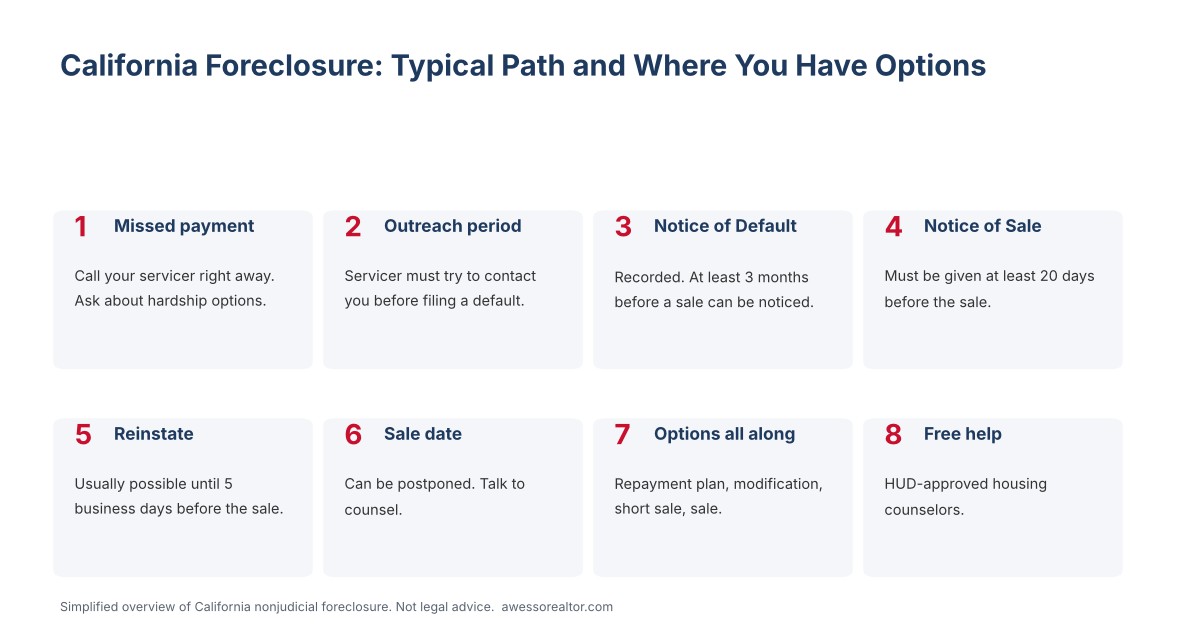
California foreclosures usually follow a nonjudicial process: after a notice of default is recorded, at least three months must pass before a notice of sale can be given, and the notice of sale must be given at least 20 days before the sale date. Homeowners can usually reinstate the loan by paying the past-due amount up to five business days before the sale. Timelines and rights depend on your situation, so talk to a housing counselor or attorney.
Why Selling Early Can Protect You
If you have equity, selling before a foreclosure sale lets you pay off the loan and keep the rest. If you don't, a short sale can often limit credit damage compared with a completed foreclosure, and California law limits deficiency claims in many short sales on owner-occupied homes. Waiting until the last minute leaves fewer choices and less time to get a good price. Find out what your home is worth so you know where you stand.
Watch Out for Foreclosure Rescue Scams
- Never pay upfront fees for loan modification help.
- Never sign over your deed to someone promising to "save" your home.
- Never stop talking to your servicer because someone told you to.
- Check that anyone helping you is licensed or HUD-approved.
A Simple Action Plan
- List your income, expenses and how much you can realistically pay.
- Call your servicer and request a loss mitigation application.
- Contact a HUD-approved housing counselor.
- Get a home value estimate to understand your equity.
- Decide whether to keep the home, sell, or do a short sale, and act before deadlines.
Documents to Gather Before You Call
- Your most recent mortgage statement and loan number
- Two recent pay stubs or proof of other income
- Last two years of tax returns or W-2s
- Two to three months of bank statements
- A monthly budget showing income and expenses
- A short hardship letter explaining what changed and when
Having these ready speeds up your review and shows the servicer you're serious.

What to Say to Your Servicer
Keep it simple and factual: "I'm having trouble making my payments because of [reason]. I want to keep my home if possible. Please send me a loss mitigation application and tell me which options I may qualify for. Who is my single point of contact?" Then ask for every deadline in writing.
Keep the Home or Sell? A Quick Decision Guide
| Your situation |
Options to explore first |
| Short-term hardship, income coming back |
Forbearance, then repayment plan or partial claim |
| Permanent drop in income, want to stay |
Loan modification |
| Can't afford it long term, have equity |
Sell before foreclosure and keep the equity |
| Can't afford it, owe more than it's worth |
Short sale or deed in lieu |
| Payment jumped because of taxes or insurance |
Ask for an escrow analysis and shortage spread; shop insurance |
If Your Payment Went Up Because of Escrow
Many California homeowners saw payments rise because property taxes or insurance premiums increased, creating an escrow shortage. Ask your servicer for a copy of the escrow analysis, check it for errors, and ask whether the shortage can be spread over 12 months or more. Shopping your homeowners insurance can also help.
Military Homeowners
Active-duty service members may have extra protections under the Servicemembers Civil Relief Act (SCRA), including limits on foreclosure for mortgages taken out before active duty. Contact your base legal assistance office and tell your servicer you're on active duty.
Related Guides
Frequently Asked Questions
How long before my lender forecloses in California?
It varies, but California requires outreach before a notice of default, at least three months between the notice of default and the notice of sale, and at least 20 days' notice before the sale. Many foreclosures take longer, and postponements are common.
Will a short sale or foreclosure hurt my credit?
Both affect your credit, and late payments do too. Acting early with a modification, sale or short sale can limit the damage. A credit counselor can explain your specific situation.
Who can I talk to for free help?
A HUD-approved housing counselor. You can also contact your servicer directly, and VA borrowers can contact VA loan technicians.
Can I sell my house if I'm behind on payments?
Yes. You can sell up until the foreclosure sale, and the loan is paid off from the proceeds. If you owe more than the home is worth, you may need lender approval for a short sale.
Need to Talk It Through?
If you're behind or worried you will be, call or text me at 951-282-7007 for a confidential conversation. I'll help you understand your home's value and your selling options, and point you to free counseling resources. No pressure, no judgment.
#MortgageHelp #ForeclosurePrevention #ShortSale #LoanModification #California #RiversideCounty #Murrieta #Temecula #VALoan #FHA #Homeowners
Sources: NAR on the VA Partial Claim Program; ATTOM 2026 mid-year foreclosure report; California Civil Code §§ 2923.5–2924c (Homeowner Bill of Rights and foreclosure notices); Consumer Financial Protection Bureau. Programs and timelines change and depend on your loan. This article is general information, not legal, tax or financial advice. Talk to a HUD-approved housing counselor or attorney about your situation.

About the Author
Wiyao Awesso
Realtor® | VA Loan Specialist & Loan Officer | U.S. Navy Veteran
Wiyao is a Murrieta-based Realtor® and licensed loan officer who specializes in VA loans and military relocation. After about 20 years in the U.S. Navy, he helps service members, veterans and first-time buyers buy, sell and finance homes across Riverside and San Diego counties, from the first showing to the closing table.
DRE# 02058584 | NMLS# 1939042 | 951-282-7007 | More about Wiyao
Get a VA Loan QuoteApply Now